
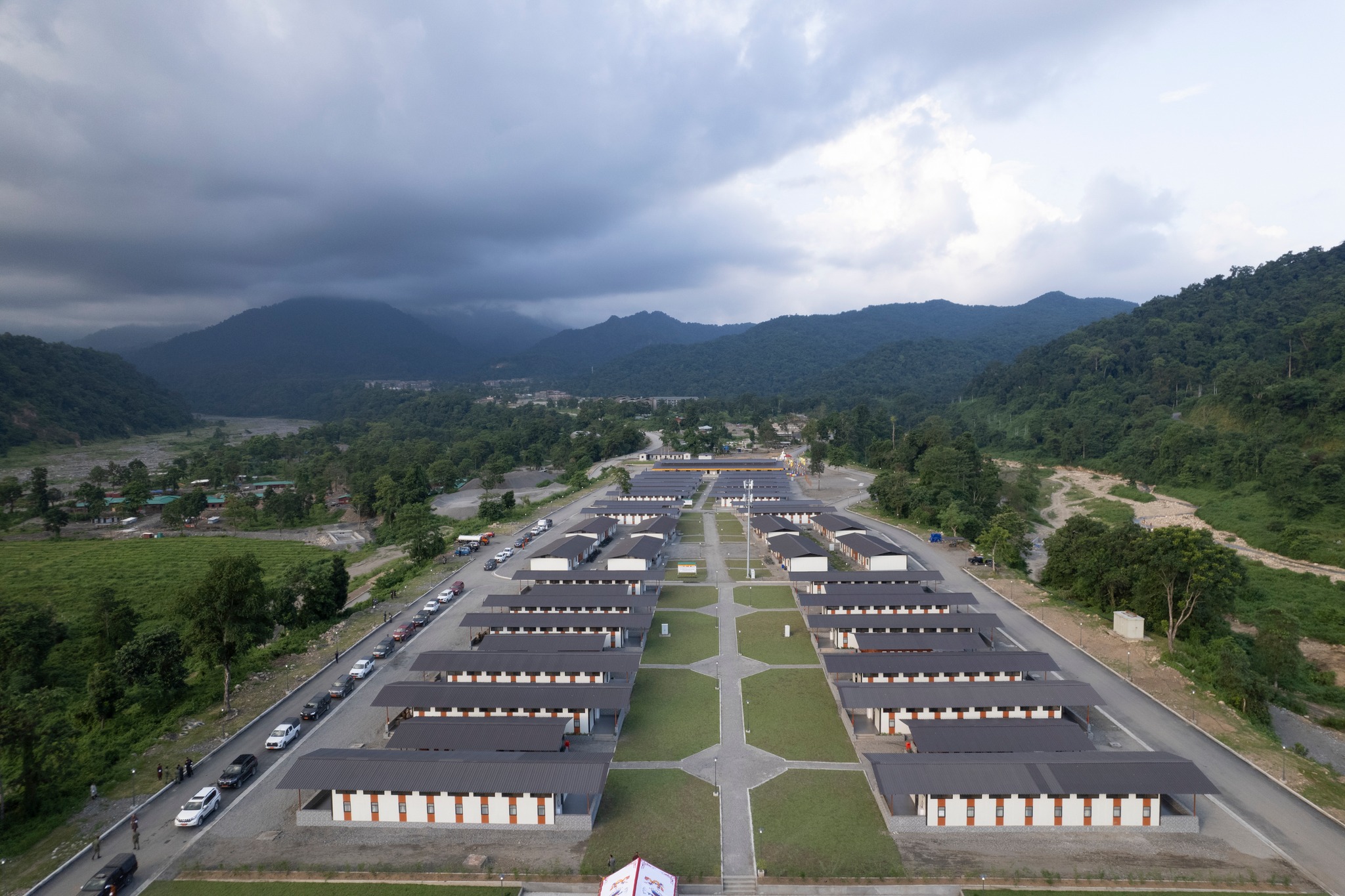
Scaling Zero Waste Implementation at Bhutan’s Gyalsung Academies
Location
Bhutan (Pemathang Gyalsung Academy, Samdrup Jongkhar)
project period
April 2026 – September 2027
client
REPIC (Renewable Energy, Energy and Resource Efficiency Promotion in Developing and Transition Countries)
Services provided
Project implementation
Consultancy
Partner organisation
Gyalsung Headquarters, Gyalsung Infra, Ecopartner
Bhutan's five Gyalsung Academies train thousands of cadets on largely self-sufficient campuses, but rapid expansion has outpaced local waste management capacity, with most waste disposed of at open dumpsites. This REPIC-funded pilot establishes Bhutan's first fully integrated Zero Waste system at Pemathang Gyalsung Academy, demonstrating a practical, replicable model aligned with the Zero Waste Bhutan Policy (2023) and laying the groundwork for nationwide scaling across all five academies.



Bhutan has made strong progress in environmental protection, yet faces growing solid waste challenges driven by rapid urbanisation and institutional expansion. The five Gyalsung Academies, each designed to host up to 7,500 cadets and staff, generate significant daily waste streams that are currently managed through a mix of informal segregation and disposal at nearby municipal dumpsites. The project directly responds to this gap by demonstrating that a cost-efficient, institutionally embedded Zero Waste system is technically and operationally feasible in the Bhutanese context.
In 2025, SKAT and Gyalsung Infra jointly prepared Zero Waste Master Plans for each of the five academies. The Pemathang plan defines a staged pathway applying the 3R principle (Reduce, Reuse, Recycle) covering composting of organic waste, sorting and marketing of dry recyclables through a Resource Recovery Park (RRP), and safe treatment of residual and hazardous waste. The project builds on SKAT and Ecopartner's experience, including from REPIC-supported projects in Costa Rica and Colombia, adapting proven training methodologies and operational models to the Bhutanese context.
The project is organised around three work packages. The first focuses on infrastructure and operational setup: procurement and installation of the RRP, composting unit with shredder, baler, and MHM incinerator, alongside the development of standard operating procedures and market linkages with local private-sector recyclers. The second centres on capacity development: a Training-of-Trainers (ToT) programme for operators and academy staff, integration of a Zero Waste curriculum into cadet training, and awareness campaigns for surrounding communities. The third covers knowledge management and replication: digital monitoring of waste flows and greenhouse gas reductions, documentation of lessons learned, and production of a replication toolkit for rollout across the remaining four academies.
The project targets a landfill diversion rate of at least 90%, a significant reduction of greenhouse gas emissions, and the training of over 1,500 cadets and staff. It also aims to obtain international Zero Waste certification from the Zero Waste International Alliance (ZWIA) – a first for Bhutan and a regional benchmark for institutional waste management. The system is designed to approach cost-neutral operation within the project period, with revenues from recyclables and compost partially offsetting operating costs.